

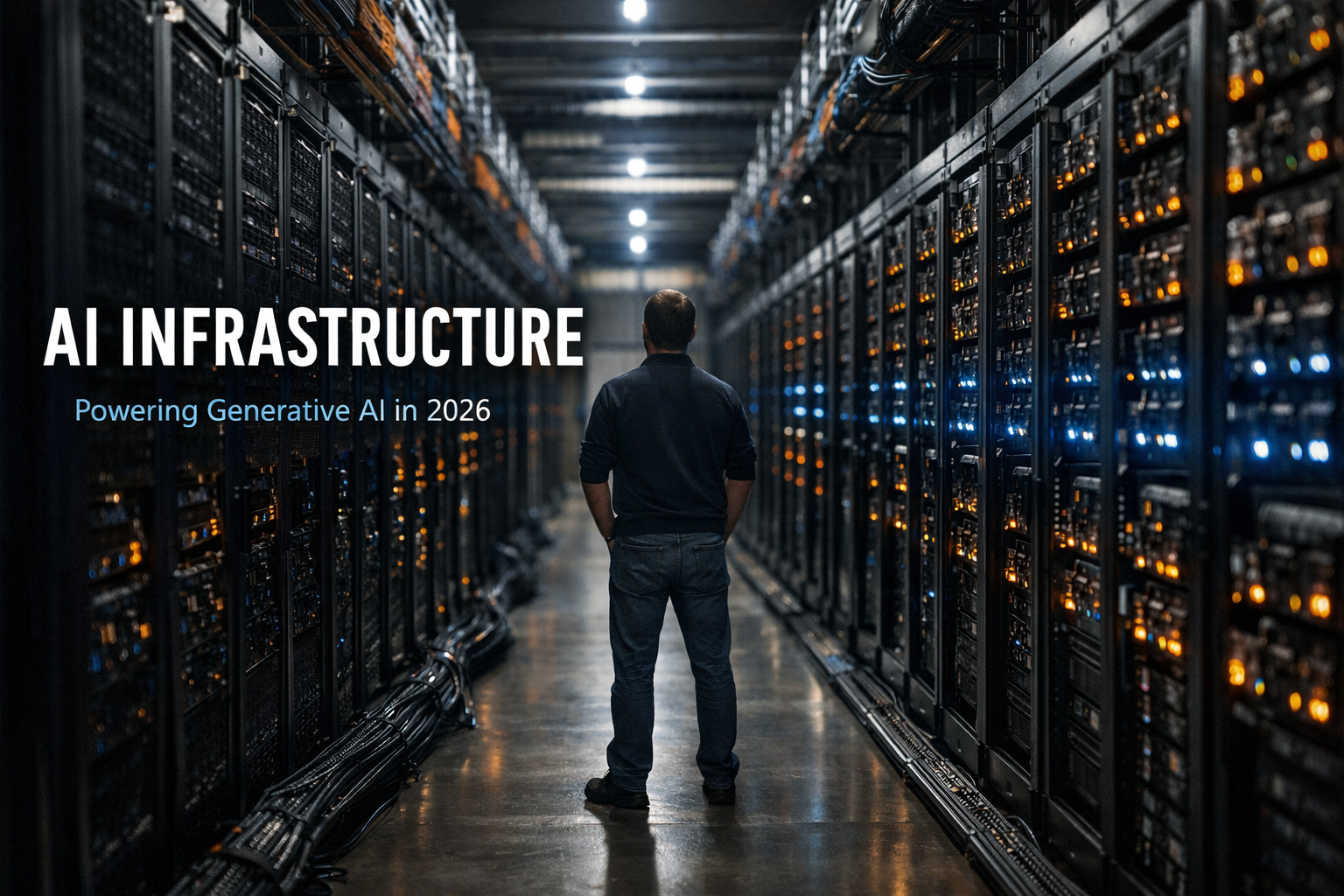
AI is now not only about algorithms but also the infrastructure required to build the system. By the year 2026, AI infrastructure has already taken its rightful place as the core of modern technology, allowing for everything from the technology powering generative AI to machine learning.
It is thanks to the capabilities offered by the AI infrastructure that it becomes possible to convert raw information into intelligent output.
What Is AI Infrastructure?
AI Infrastructure involves both hardware, software, and networking components necessary for developing, training, and deploying AI models. They include the following elements:
- High-performance computing (HPC) systems
- GPUs and specialized AI chips
- Cloud computing platforms
- Data storage and pipelines
- Networking and security systems
The difference between AI Infrastructure and traditional IT systems is that AI Infrastructure is developed to support heavy computational operations, particularly generative AI.
Core Components of AI Infrastructure in 2026
1. GPUs and AI Chips
The GPU is considered to be at the center of AI Infrastructure, where all the parallel processing required to train models can be done.
- GPUs account for nearly 40% of data center costs
- Companies like NVIDIA dominate this space due to unmatched performance
Furthermore, specialized chips like the TPU and ASICs are now being introduced.
2. AI Data Centers
Data centers today are transforming into “AI factories,” which are essentially data centers that have been developed for carrying out extensive AI computations.
- AI infrastructure spending could reach $1.4 trillion annually by 2030
- Data centers now focus on compute power, not just storage
They use high-density GPU clusters, state-of-the-art cooling techniques, and vast power capacities.
3. Cloud Computing for AI
AI platforms such as AWS, Google Cloud, and Azure enable scalability in AI infrastructure without necessitating companies to create their own infrastructures.
- Approximately 74% of businesses favor hybrid cloud deployments for AI implementations.
Cloud computing allows businesses to:
- Scale AI models instantly
- Reduce upfront hardware costs
- Access cutting-edge AI tools globally
Why AI Infrastructure Is Booming in 2026
The emergence of generative AI has generated an unparalleled need for processing power.
- AI workloads are growing so fast that infrastructure is struggling to keep up
- Hyperscalers invested over $300 billion in infrastructure in 2025, with even higher spending expected
This surge is driven by:
- Chatbots and generative AI tools
- Enterprise AI adoption
- Automation across industries
AI is no longer experimental, it’s operational.
Key Trends Shaping AI Infrastructure
🔹 1. AI-First Data Centers
Data centers are shifting toward GPU-driven architectures optimized for AI workloads rather than traditional computing.
🔹 2. Energy and Power Challenges
AI systems require enormous electricity:
- AI data centers could consume up to 1% of global power by 2030
This is pushing innovation in cooling systems and energy efficient infrastructure.
🔹 3. Rise of AI Cloud and Hybrid Systems
Businesses are adopting multi-cloud and hybrid infrastructure for flexibility, security, and scalability.
🔹 4. Specialized AI Hardware
New chips and architectures are being developed specifically for AI to improve performance and reduce costs.
Challenges in AI Infrastructure
Despite rapid growth, AI infrastructure faces major challenges:
- High Costs: GPUs and data centers require massive investment
- Energy Consumption: Power demand is rising rapidly
- Scalability Issues: Infrastructure struggles to match AI growth
- Security Risks: AI systems require advanced protection
These challenges are shaping the future of how AI systems are built and deployed.
The Future of AI Infrastructure
Looking ahead, AI infrastructure will become even more critical as AI integrates deeper into everyday life.
We are moving toward a world where:
- AI runs continuously in real time
- Infrastructure becomes more automated and intelligent
- Data centers act as industrial-scale AI production hubs
In simple terms, AI infrastructure is becoming the new digital backbone of the global economy.
Conclusion
AI systems might hog the limelight, but they need strong infrastructure to function well.
Without high-end GPUs, highly scalable cloud computing systems, and state of the art data centers, modern AI would not have been possible.
As we continue further into 2026, there is no doubt that the following fact will become increasingly evident:
👉 The success of future artificial intelligence lies in its infrastructure.
Leave feedback about this